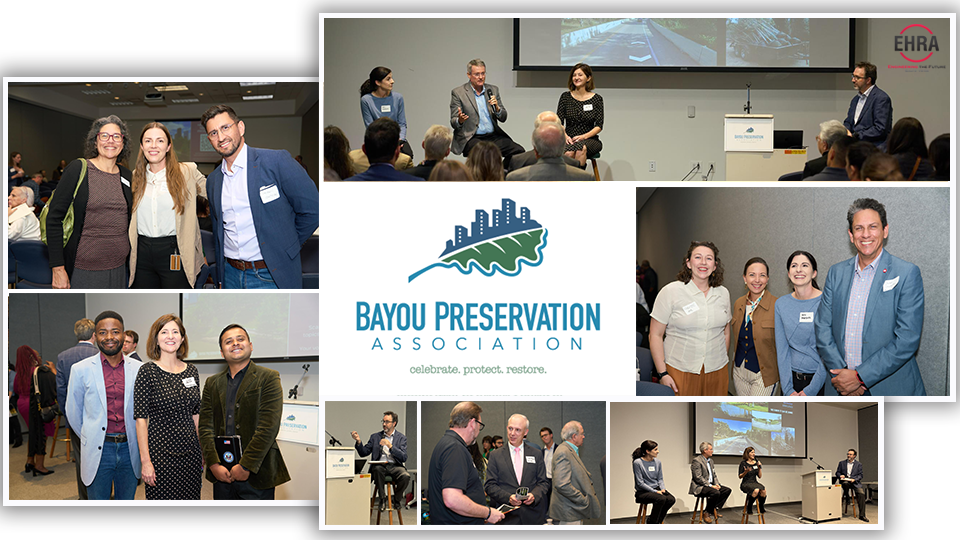
The importance of greenspace and walkability is at an all-time high. People want to get outside, people want to see, people want to experience. There are so many great things Houston has to offer, why hide ourselves indoors? The Bayou Preservation Association fought to discuss and come up with solutions to solve the walkability crisis, while staying green at the Bayou Preservation Association Fall 2025 symposium.
Partaking in the topic at hand includes keynote speaker, Cassie Hoeprich with Downtown Houston+, panelists, Kelli Ondracek with Houston Parks and Recreation Department, Ethan Beeson with Tx DOT and Lisa Graiff with Houston Parks Board – industry professionals with different roles and varying company agendas, all coming together to promote the greener Houston. Bringing a sense of liveliness, banter and quality information to fellow industry professionals, problem solvers and curious minds.
Our very own Chris Browne, LEEP AP led the discussion as he was given the opportunity to moderate this panel. Encouraging, growth and resiliency in obtaining a greener on ground level, more walkable and improved environment. Chris has been with Bayou Preservation Association since his start at EHRA Engineering about 18 years ago and has been in the industry for 30+ years. He has seen Houston through many different phases, but as cities continue to grow and get older, you must rebuild the city, and that is what they’re planning to do.
Through talking with Chris about his experience of this latest symposium, I came to learn about not only the history of Houston, but the history of Bayou Preservation Association. BPA was founded by Terry Hershey, a force of nature and true environmental activist. She fought hard to preserve the bayou systems, one of Houston’s great features, with Congressmen at the time, and later President George H. W. Bush. Thanks to her and the creation of BPA, the bayous have been protected and parks are being saved. We now want to continue fighting to bring the environment back to Houston.
As we all know, and if you don’t, you might want to take a trip outside for a few minutes; Houston is hot. To combat the heat, Downtown built an intricate underground tunnel system, which we could all agree is pretty cool, in more ways than one. Which begs the question of how do we get people outside? Especially as the city grows and more iconic events appear, we want them to experience all the good things Houston has to offer. Cassie Hoeprich spoke on making Downtown more walkable through adding more greenery on the ground level and more Houston art throughout the city, especially downtown.
As we continue to expand the Houston metroplex, we are building master planned communities with an emphasis on creating cohesive environments involving nature, walkability and convenience. When we look back at the big city, we don’t see much of that. We want to bring the green back to the city; we want the city to become more fluid. Houston also struggles with a huge traffic issue, simply because there are so many of us here, so many of us working and going about our day – if we made the city more walkable, we could cut back on that. Of course, that is easier said than done, but Chris and the panelists fought hard to turn the narrative, offering solutions and fostering new ideas. Considering building paths within power line and pipeline easements to connect with the bayou trails to find ourselves a grid to walk on. Planting wildflowers and non-invasive plants along the paths to keep the city green. Creating partnerships with major powerhouses in Houston to make all of that possible. Even planting trees along the highway.
It wasn’t just the panelist involved in this discussion. The approach Chris takes to moderating is not like most; he strives to foster a conversation, inviting the crowd to feel included in the discussion. While the BPA spends months planning for the symposium, hand selecting panelist and curating a list of questions to keep the conversation going, Chris also allows space for audience questions. A crucial step in keeping the audience engaged and the creative juices flowing. The audience wants to learn, wants to grow and what better time to give them the space to do so. One of Chris’ favorite questions came from an audience member, asking about how to protect trees during construction projects. The answer came very simply; you can’t protect everything, and don’t get too greedy with the space you block off. A simple answer, a simple question, but it shows that the audience cares.
Once again, people want to get outside, they want to see and they want to experience. It is our time to let them and transform our city for the greener good. We are all changing, we are all growing and the city is doing that right there with us. Building a stronger environmental aspect to major cities is the next step.
We at EHRA Engineering are honored to help mandate the change; it starts with a conversation. We’d like to thank you, Chris Browne, for sharing your experience and leading a great conversation. Thank you to the Bayou Preservation Association for standing up for the natural beauty of our bayous within the growth of our city and leading the change.